Climate Change
Management
Challenges, Risks,
and Impacts
Climate change is a critical global concern, evident in the United Nations Sustainable Development Goals (SDG 13: Climate Action) and regularly addressed at the Conference of the Parties to the United Nations Framework Convention on Climate Change (COP).
Thailand is committed to achieving the long-term goal of Net Zero GHG Emissions by 2065. This commitment is accelerating efforts for both public and private sectors to manage greenhouse gas emissions more effectively through the drafting of the National Climate Change Act, or Global Warming Act, which will take effect soon. Additionally, there is a strong emphasis on national clean energy production and utilization to respond to the forthcoming changes in consumption patterns and stakeholder expectations in the energy sector. Thaioil Group has recognized these challenges and considers them as risks and opportunities for the Company to determine the most effective targets and long-term strategies.


The Board of Directors and executive management of Thaioil Group and its subsidiaries have acknowledged the importance of steering future business towards a clean energy business and a low-carbon society. The Company has established a policy in alignment with the Paris Agreement and Thailand’s Nationally Determined Contribution (NDC).
The Company focuses on feasibility studies of new businesses, including high-value environmentally friendly products and process optimization for maximum efficiency. Moreover, the Company has determined tangible strategies and established long-term targets in line with national commitments.
Targets

GHG emission reductions (Scope 1 and 2)
2023 Target
-
Percent compared with base year
Long-term Target
15
Percent compared with the base year in 2026
GHG emissions (Scope 1 and 2)
2023 Target
Less than 3,460,000
Ton of carbon dioxide equivalents (tCO2e)
Long-term Target by 2050
Carbon Neutrality
Long-term Target by 2060
Net Zero GHG Emission

Management Approach
and Performance
Governance and Oversight
The Board of Directors conducts an annual review of corporate climate change strategies and adopts risk management process as a tool to assess climate change’s impact on future business operation. Climate risks are monitored on a quarterly basis.
The Board also tracks climate-related key performance indicators including Energy Intensity Index and Greenhouse Gas Intensity, which are part of the Corporate Key Performance Indicators, to evaluate the performance of management executives and employees.
In 2023 strategic review, the Board endorsed the Net Zero GHG Emissions Pathway 2026–2060 and considered budget and investment approach in low carbon technology, such as studying the installation of Carbon Capture technology in production unit, studying Blue and Green Hydrogen business, and studying Sustainable Aviation Fuel (SAF) production.
The Board of Directors has assigned the Corporate Governance and Sustainability Committee (Board level) to oversee and monitor the progress on a semi-annually basis. The Sustainable Development Steering Committee (Executive level), chaired by the Chief Executive Officer and President, is assigned to drive the implementation, and monitor the progress on a quarterly basis. The management of Thaioil Group are responsible for managing implementation in line with the established strategy. The “Net Zero GHG Emissions Governance Structure” is established where the Vice President of the Sustainability Function is supervising overall management. The structure consists of Strategic Planning Function, Production Function, Business Development Function, Research and Development Function, Finance Function, and Corporate Social Responsibility Function. These functions are responsible in assessing climate-related risks and opportunities, including aligning their work as per the organizational climate strategy, developing action plans and Thaioil Group’s Net Zero GHG Emissions Pathway and Roadmap, and regularly reporting performances as well as risks and opportunities management to the committees.

Level | Roles and Accountabilities | Meeting Frequency |
|---|---|---|
The Board of Directors | • Oversee the corporate climate change strategies, execution roadmap and performance. | As needed |
The Corporate Governance and Sustainability Committee – Board level
| • Define and review sustainability strategy, plan, and goals, which include climate related issues.
• Oversee the setting of climate-related targets.
• Oversee and monitor the development and implementation progress of corporate climate change strategies, roadmap, and climate-related key performances. | Semi-annually |
The Sustainable Development Steering Committee – Executive level | • Drive the implementation, and monitor the progress of corporate climate change strategies, climate risks management and mitigating actions and the development of a climate transition plan.
• Review and approve the annual sustainability material topics, including climate actions along with corporate sustainability strategies.
• Review and endorse Thaioil Group’s Net Zero GHG Emissions Pathway, including the interim target to reduce GHG emissions by 15% by 2035 from the base year of 2026. This is consistent with Thaioil Group’s Carbon Neutrality target by 2050 and Net Zero GHG Emissions target by 2060.
• Steer and support various internal functions to actively participate in integrating operations towards a sustainable organization across all ESG dimensions. This included approving key sustainable development plan to achieve Thaioil Group’s sustainability targets. | Quarterly |
The “Net Zero GHG Emissions Governance Structure” | • Assess climate-related risks and opportunities, including aligning their work as per the organizational climate strategy, developing action plans and Thaioil Group’s Net Zero GHG Emissions Pathway and Roadmap, and regularly reporting performances as well as risks and opportunities management to the management, executives and Board committees. | As needed
|

Climate Strategy
Thaioil Group defines the Net Zero GHG Emissions Strategy, known as the 3Cs strategies, with the details as follows:

Participation in trade associations to drive change
Thaioil Group collaborates with PTT Group, a leading energy company in Thailand, to study and brainstorm government laws and policies supporting Net Zero GHG Emissions under the PTT Group Net Zero Task Force (PTT G-NET) working team.
This working team consists of several sub-working groups to jointly study, advocate, and propose operational approaches to achieve the target. The approaches include Carbon Capture Utilization and Storage (CCUS), the use of hydrogen as an alternative energy source, increasing production potential by utilizing renewable energy to replace fossil fuels, and engaging in reforestation initiatives for the benefits of carbon credits.
Furthermore, Thaioil Group has been a member of Thailand Carbon Neutral Network (TCNN) since 2021, aiming to actively engage in public policy regarding climate change. TCNN operates under the Thailand Greenhouse Gas Management Organization (TGO) with the objective of creating a network among public and private sectors to advocate for public policies that support the Carbon Neutrality and Net Zero goal in Thailand’s Nationally Determined Contribution (NDC). Thaioil Group consistently reviews and monitors TCNN’s objectives related to climate movement regularly to ensure that Thaioil Group’s climate position and net zero commitment are aligned with TCNN. In case of any misalignment between TCNN and Thaioil Group’s position in climate change policy, the Company may reconsider its membership.

Climate-related Risk and Opportunity Management
Thaioil Group has evaluated the resilience of the Net Zero GHG Emissions Strategy through a scenario analysis, as well as the business impacts of each climate change scenario. The analysis of climate-related risks and opportunities was assessed for the years 2030, 2040, and 2050. According to the Task Force on Climate-related Financial Disclosure (TCFD) recommendation, the analysis was conducted in 2 scenarios compared with the baseline scenario as described below:
The Transition Scenario Analysis
Thaioil Group assessed climate-related risks and opportunities by considering 4 factors, namely: regulatory; technological; market; and reputational. The two scenarios were assessed for the years 2030, 2040, and 2050 across the value chain, from upstream to downstream, as follows:
Stated Policies Scenario (STEPS)
This scenario represents a pathway that considers the current policies and targets announced by governments in alignment with the Nationally Determined Contributions under the Paris Agreement.
Sustainable Development Scenario (SDS)
This scenario represents a “well below 2°C” pathway achieved through transitioning into a low-carbon economy and meeting all current net zero pledges of the International Energy Agency (IEA).
Climate-related risks and opportunities by considering 4 factors


Regulatory Risk
Risk and Opportunity

Besides, carbon pricing can pose a risk in upstream operation. Particularly, in the case that the origin country of crude oil suppliers mandates the carbon price. This could result in an increase of the Company’s raw material costs. In downstream operations, likewise, the risks of carbon pricing can be posed by the execution of the EU’s Carbon Boarder Adjustment Mechanism (CBAM). This may impact the prices of some petrochemical products of the Company that is exported in the European market.
With these situations, the oil industry business might face challenges in adaptation. Also, the Company may encounter the risks on higher costs and long-term shift towards clean energy. However, the government initiatives present opportunities for the Thaioil Group to formulate its business strategy. For instance, if the government advocates or offers incentives for investing in clean energy ventures, such as hydrogen production or sustainable aviation fuel, it could facilitate Thaioil Group’s adaptation to change its business landscape.
Mitigation Measures

Closely monitoring the progress of regulatory enforcement.

Conducting Sensitivity Analysis for Carbon Pricing.

Joining membership of the greenhouse gas-related associations such as Thailand Carbon Neutral Network (TCNN) and Thailand Business Council for Sustainable Development (TBCSD) to monitor the regulatory enforcements and directions for the private sector.

Monitoring the impacts of carbon prices in case of transmission from crude oil suppliers and conducting appropriate sourcing strategies.
Technological Risk
Opportunity
Mitigation Measures
Conducting feasibility study for the use of carbon capture technology in the production process.
Participating in a feasibility study of applying carbon transportation and storage in the Eastern region with PTT Group.
Seeking business opportunities in carbon utilization for commercial use.
Seeking business opportunities in blue or green hydrogen business.
Seeking business opportunities in New S-curve Business
Market Risk
Opportunity
could cause an uncertainty in business revenue. Besides, the trends of energy transition occurring in many countries may impact future markets while the growing demands of electric vehicles may disrupt the needs for oil and other fossil fuels.
Moreover, the National Electric Vehicle Policy Committee (EV Board) has announced the 30@30 policy. The goal is to produce Zero Emission Vehicle (ZEV) – vehicles emitting zero emissions – at least 30 percent of the total vehicle production by 2030. In 2023, the EV board issued measures to support the use of electric vehicles in Phase 2 or EV 3.5 over a 4-year period (during 2024-2027). These measures are expected to accelerate the rapid behavioural change in consumer behaviour towards ZEVs.
With the growing demand for clean and renewable energy, Thaioil Group has recognized the impacts on its product sales in both the short- and long-terms. However, the energy transition also creates opportunities for the Company to explore new business investment and new products.
Mitigation Measures
Adjusting gasoline production ratio in alignment with the decreasing demands in the future. Increasing the production efficiency of investing in diesel and aviation fuel production through Clean Fuel Project (CFP).
Adjusting the structure of business portfolio to support the future market.
Analysing the peak oil demand and consistently tracking market trends to refine the product portfolio structure accordingly.
Investing in PT Chandra Asri Petrochemical Tbk (CAP), a leading petrochemical company in Indonesia, to adjust the structure of the product portfolio towards the high-demand chemical market.
Conducting the feasibility study of biofuel.
Joining the feasibility study of sustainable aviation fuel (SAF) with PTT Group.
Continuously engaging with customers to perceive their future product needs and adjusting the business strategies to focus on high-value products, specialty chemicals products, and commodity products.
Reputational Risk
Opportunity
The factors that may affect Thaioil Group deal with an insufficient action to mitigate climate-related impacts in response to the expectations of stakeholders such as societies, communities, employees, shareholders, and creditors.
Mitigation Measures
Declaring net zero GHG emissions commitment.
Developing a net zero GHG emissions pathway.
Constantly communicating on the progress.
Joining groups and organizations that promote sustainable development and national commitments.
Result of
Financial Impact Assessment
Key Risks
- Impact of carbon pricing: This results from the release of carbon dioxide equivalents emissions from the Company’s production processes. The scenario analysis has been conducted under the assumption that Thailand adopts the GHG Emission Trading Scheme (ETS), and the control capacity is referred to the volume of GHG emission by Thaioil Group for the year 2023. References to carbon prices for the years 2030 and 2050 in the Asian regions are based on the IEA World Energy Outlook 2021.
- Impact of declining demands on the Company’s products from the shift to use alternative energy (Downstream): These results are based on the demands for oil products in ASEAN, referencing the IEA World Energy Outlook 2021.
- Impact of carbon pricing from the increasing crude oil price by crude oil suppliers (Upstream): These results are based on the assumption the crude oil suppliers are affected by carbon taxes and pass on the costs to the Company’s cost at 100%.
The Physical Scenario Analysis
Thaioil Group assessed physical risks of both acute and chronic impacts from rising global temperature. The scenario analysis has been conducted for the years 2030, 2040, 2050 across supply chain, from upstream to downstream. Representative Concentration Pathways (RCPs), an internationally recognized climate model of the Intergovernmental Panel on Climate Change (IPCC), has been applied in two scenarios as follows:
The RCP 2.6 scenario represents a stringent greenhouse gas reduction measure.
The RCP 8.5 scenario represents a rapid increase in greenhouse gas emissions.
Climate-related risks and opportunities by considering 2 factors


Water Scarcity
Risk
Mitigation Measures
To balance between business interests and stakeholders’ expectations, Thaioil Group has agreed with government agencies to give importance to the community as the first priority during water shortages. This is to ensure the surrounding communities have adequate water irrigation for agriculture and consumption for their daily needs before any allocation to Thaioil Group. Furthermore, Thaioil Group has established a “Long-term Water Supply Strategy 2023–2033” to ensure water security and reduce the risk of water scarcity that may impact both business operations and future expansion projects. Thaioil Group’s water management is summarized as follows:
At the present, Thaioil Group uses two types of water. The seawater is processed to freshwater through the Thermal Desalination unit. The raw water is sourced from two different water distributors namely the Bang Phra Reservoir, which is operated by the Royal Irrigation Department, and the Nong Kho Reservoir, which is operated by the Eastern Water Resources Development and Management Public Company Limited. Both water distributors operate integrated water systems alongside Thaioil Group through aligning practices with government policies or the local context of shared water use in the area. This is to ensure adequate water supply within Thaioil Group’s production processes, such as the cooling tower system, demineralization for steam production, and other production processes. The Company consistently improves and monitors water quality to exceed the required standards before discharging into the environment. To further minimize the impacts on the ecosystem, the circular economy and 3Rs (Reduce, Reuse, Recycle) principles are adopted in water management to maximize the utilization efficiency.
There are ongoing feasibility study projects under the “Long-term Water Supply Strategy 2023–2033” as follows:
1. A study project on installing additional desalination units from six existing units. This project aims to increase the proportion of water consumption from seawater, which is considered an unlimited natural resource, to replace freshwater consumption, which is considered a limited natural resource.
2. A study project on the recycled wastewater from the water treatment plant.
3. A study project on reverse osmosis system for recycling wastewater.
4. A study project on Pattaya wastewater recycle to reuse wastewater in the urban communities.
Moreover, under construction project is as follows:
A raw water utilization project from the private pond
Other Physical
Risks
Mitigation Measures

Predicting and monitoring cyclone events and relevant warning system.

Preparing the production and delivery of products plan in advance before offshore cyclone occurs.

Reviewing and developing emergency measures to prevent cyclone-related harm.
Result of
Financial Impact Assessment
Key Risk
- Impact of water shortage: In case that the government sector reduces water supply to the Company by 10%, the Company must align its investments with the Long-term Water Supply Strategy. The Company is required to consider increasing the volume of freshwater from private sources and freshwater production from seawater by the Thermal Desalination Unit. Additionally, the Company needs to prepare the water reservation plan in appropriate areas to provide adequate water in the production process. However, these measures could increase production cost.
- Impact of offshore cyclone events: The Company’s revenue could decline from the cyclone event, particularly in the case that the Company is unable to deliver the products through marine freight during the offshore cyclone event. Also, pre and post-cyclone events could disrupt the production process. In the pre-cyclone event, the Company must ensure worker safety and prevent damage to machinery and equipment. In the post-cyclone event, workplace inspections need to be conducted before operating the business as usual.
2023
Performances
To achieve Thaioil Group’s Net Zero GHG Emissions target, the Company has implemented projects to reduce the direct GHG emissions in the production process. The performance of Thaioil Group in 2023 is outlined as follows:
Reduction of Direct Greenhouse Gas Emissions (Scope 1)
(Scope 1)
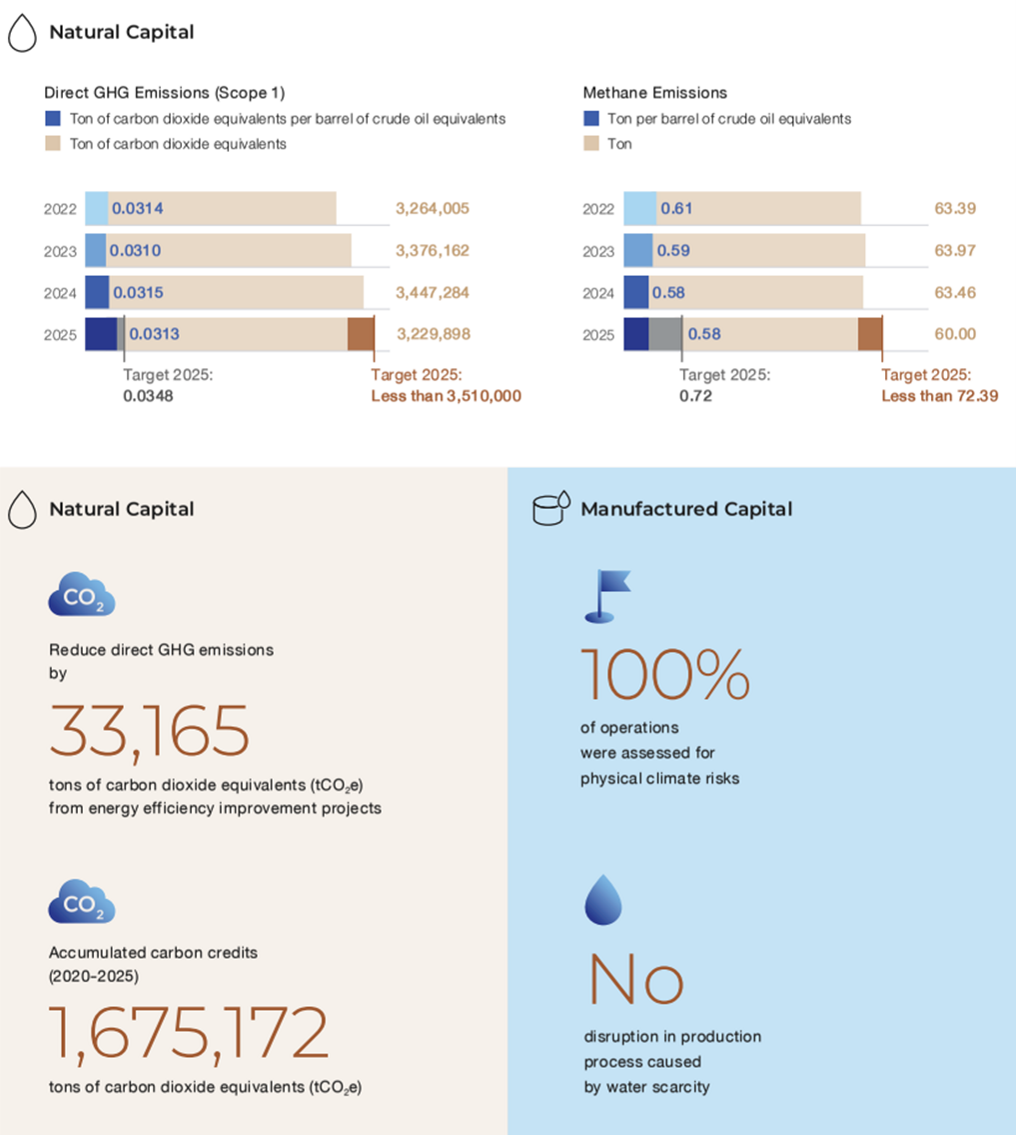
Thaioil Group has implemented 23 Energy Efficiency Improvement (EE) projects. Key initiatives include the project to enhance power production efficiency by optimizing GHG utilization for Gas Turbines at TOP SPP Co., Ltd., and the project to optimize energy consumption by operating all Sulfur Recovery Units. These initiatives have resulted in a reduction of greenhouse gas emissions by more than 36,115 tons of carbon dioxide equivalent (tCO2e). Consequently, the Scope 1 and 2 GHG Emission Intensity stood at 0.0316tons per million barrels of crude oil equivalent (MBOE), which is lower than the set target of 0.0354 tons per MBOE.
In addition, Thaioil Group has implemented renewable energy projects to support the greenhouse gas reduction goals and the national emission reduction targets. This includes the expansion of the Cogeneration Power Plant in Si Racha District, Chonburi Province, operated by TOP SPP Co., Ltd., which increased its capacity from 239 megawatts to 354 megawatts.
Moreover, the aforementioned greenhouse gas management has successfully controlled methane emissions within the specified targets, as the majority of Thaioil Group’s methane emissions originate from the same sources as its greenhouse gas emissions.
For the year 2025, Thaioil Group has received the following certifications and awards for its greenhouse gas emission reductions:
- Climate Action Excellence Awards 2025: Thai Oil Public Company Limited received the Climate Action Excellence Award, the highest distinction within the Climate Change Awards, from the Climate Change Institute of the Federation of Thai Industries. This recognizes Thaioil Group as a leader in concrete, multidimensional climate management and its efforts in driving the expansion toward a Low Carbon Society.
- T-VER Project Extension and Capacity Expansion: TOP SPP Co., Ltd. Has extended and expanded the scope of its T-VER project at the Si Racha Cogeneration Power Plant from 239 MW to 354 MW. The project is currently processing additional carbon credit certifications. To date, it has achieved a cumulative certified carbon credit total of over 1,674,618 tCO2e (from 2020–2024).
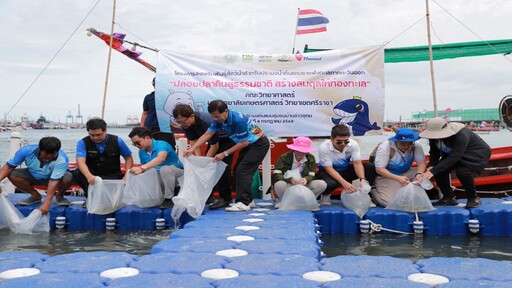
- T-VER Registration for Mangrove Reforestation: Thai Oil Public Company Limited’s 2025 “Sustainable Mangrove Reforestation Project” in Trang Province, in collaboration with the Department of Marine and Coastal Resources, has been officially registered as a T-VER project by TGO. Covering 300 rai, the project is expected to sequester or reduce greenhouse gases by approximately 825 tCO2e per year.
- Carbon Footprint of Product (CFP) Certification: Thai Oil Public Company Limited, Thai Lube Base Public Company Limited, Thai Paraxylene Co., Ltd., and LABIX Co., Ltd. Received CFP certifications from TGO. Thaioil Group now has the CFP certifications that cover the entire petroleum and petrochemical businesses. The Company plans to expand CFP assessment to TOP SPP Co., Ltd. Products and progress toward Carbon Footprint for Organization (CFO) assessments across Scopes 1–3.
- Low Emission Support Scheme (LESS) Certification: Several entities within Thaioil Group, including Thai Oil Public Company Limited, Thai Lube Base Public Company Limited, Thai Paraxylene Company Limited, LABIX Company Limited, TOP SPP Company Limited, and Sak Chaisidhi Company Limited, received LESS certificates from TGO for self-implemented energy conservation initiatives. Key projects include the Catalyst replacement in Hydrocracking Unit 1 and the temperature optimization of Benzene at the Detal Plus unit. These initiatives reduced emissions by 2,748 tCO2 This marks a significant achievement, as the Company has now received LESS certifications across its core business segments: Petroleum, Petrochemical, and Power. Since 2016, Thaioil Group has achieved a total emission reduction of 74,429 tCO2e through energy conservation and related support activities.
- LESS Friendship Awards 2025: Thai Oil Public Company Limited received the Best Organization, Silver Level category, from TGO for its consistent role in reducing emissions through the LESS program and for promoting sustainable emission reduction and carbon sequestration practices among its partners.
- T-VER Awards 2025: TOP SPP Co., Ltd. Received the Best Carbon Credit Project Award in the Energy and Heat Production Efficiency Improvement category, recognizing it as an organization with the highest cumulative certified carbon credits of 1,674,618 tCO2
- Royal Forest Department Recognition Plaque 2025: Thai Oil Public Company Limited was honored for its contributions to forest resource restoration and development. This plaque from the Royal Forest Department recognizes the Group’s support in planting and restoring 8,300 rai of forest in Phrae Province for both conservation and carbon credit benefits.
The Thai Oil Group has set long-term, medium-term, and annual targets. The annual targets are evaluated based on the energy consumption of the business plan for each year. Through the implementation of energy efficiency improvement projects in the production process in 2025, the Thai Oil Group is expected to achieve its greenhouse gas emissions target for Scope 1, as outlined, as follows:
Solar Rooftop at Thaioil’s Buildings Project
Thaioil Group has participated in the Thailand Voluntary Emission Reduction Program (T-VER), organized by the Thailand Greenhouse Gas Management Organization (Public Organization) under the project “Solar Rooftop at Thaioil’s Buildings.”
239-MW Combined Cycle Co-Generation Power Plant Project
Thaioil Group has participated in the Thailand Voluntary Emission Reduction Program (T-VER) organized by the Thailand Greenhouse Gas Management Organization (Public Organization) under the project “239-MW
Energy Efficiency Improvement Projects
The Low Emission Supporting Scheme (LESS) project, implemented through energy conservation activities aimed at improving energy efficiency within the Thai Oil Group
Reduction of Indirect Greenhouse Gas Emissions (Scope 2)
Thaioil Group has indirect greenhouse gas emissions (Scope 2) from the purchased electricity with the total of 34,628 tons carbon dioxide equivalents (tCO2e) or 1.06% of greenhouse gas emissions (Scope 1 and 2), which meets the target for greenhouse gas emissions under Scope 2, set at no more than 60,000 tons of carbon dioxide equivalents.
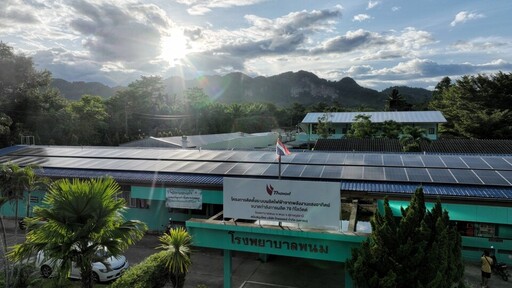
Furthermore, Thaioil Group has implemented energy efficiency improvement projects through the use of renewable energy. This includes the utilization of electricity generated from solar rooftop systems installed at the Sattiwat Wirun Building, the Thaioil Auditorium, Parking Building 2 (in front of the laboratory), and the Engineering Office Building.
Reduction of Indirect Greenhouse Gas Emissions (Scope 3)
In 2025, Thaioil Group’s Other Indirect Greenhouse Gas Emissions (Scope 3) within the value chain totaled 42,607,525 tons of carbon dioxide equivalent (tCO2e), successfully achieving the set target of less than 50,000,000 tCO2e. This performance was driven by the following key initiatives as follow:

Supported green procurement of environmentally friendly products and services from suppliers, achieving 99%, which was higher than the 97% target. The Company planned to reduce greenhouse gas emissions, such as leasing electric vehicles (EVs) for use at the Bangkok and Si Racha offices and replacing conventional light bulbs with LEDs.
Studied and created opportunities to increase the value of waste disposed to landfill. The 3Rs method was adopted to control and reduce GHG emissions. In 2025, Thaioil Group successfully maintained zero waste to landfill performance against the set target.
Conducted product study and development projects to prepare for the International Sustainability and Carbon Certification (ISCC).
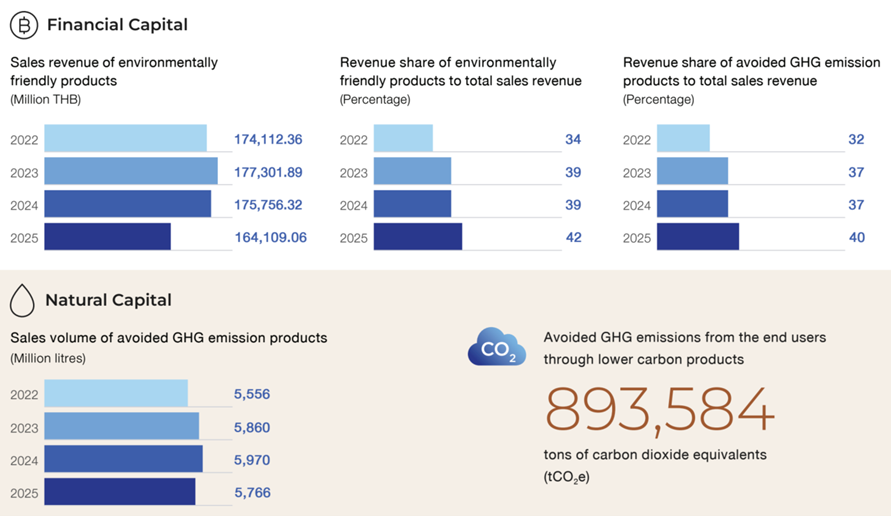
Sold low-carbon products to reduce downstream greenhouse gas emissions for consumers, including biodiesel, gasohol, bioethanol, Linear Alkyl Benzene (LAB), Heavy Alkyl Benzene (HAB), Keen cleaning products, clean rubber oil, low-sulfur fuel oil with a sulfur content not exceeding 0.5%, and benzene-free solvents.
In 2025, Thaioil Group had 5 environmentally friendly product categories, and 9 types of products that contribute to climate change mitigation in alignment with the objectives of the EU Taxonomy Framework as follows:
Green Product Category | Product Sold by Thaioil Group | Company | Sales Value (Million THB) | Sales Volume |
|---|---|---|---|---|
Bio-based product
| Ethanol from cassava
| Thaioil Ethanol Company Limited (TET) | 1,715.70 | 56.40 million litres
|
Biodegradable Product
| Linear Alkyl Benzene (LAB) | LABIX Company Limited (LABIX) | 6,312.73 | 133,922.19 tons |
Heavy Alkyl Benzene (HAB) | 80.94 | 2,380.53 tons
| ||
Compostable Product | Cleaning products (KEEEN)
| TOPNEXT International Company Limited (TX) | 0.60 | 3.40 tons
|
Products that reduce emissions released to the environment (Emission Reduction)
| Benzene-free solvents, including:
| TOPNEXT International Company Limited (TX) | ||
– TOPSol BF: Benzene Free | 57.97 | 1,349.19 tons | ||
– Xylene (Isomer): Low Ethylbenzene | 1,470.41 | 56,782.18 tons | ||
Products with lower GHG emissions than products of the same group in the market (Avoided GHG Emission Product)
| Cyclopentane CP80 and CP97, which are agents that can replace use of CFCs and HCFCs | TOPNEXT International Company Limited (TX) | 21.10 | 338.70 tons |
Gasohol
| Thai Oil Public Company Limited (TOP) | 39,084.60 | 1,439.73 million litres
| |
Biodiesel
| 117,821.28 | 4,326.50 million litres
|

Download Documents
Update : February 2024