Thai Oil Public Company Limited (TOP) announced its Q1/2026 operating performance, while underscoring the positive market outlook alongside close monitoring of market conditions and comprehensive risk management plans to navigate ongoing volatility.
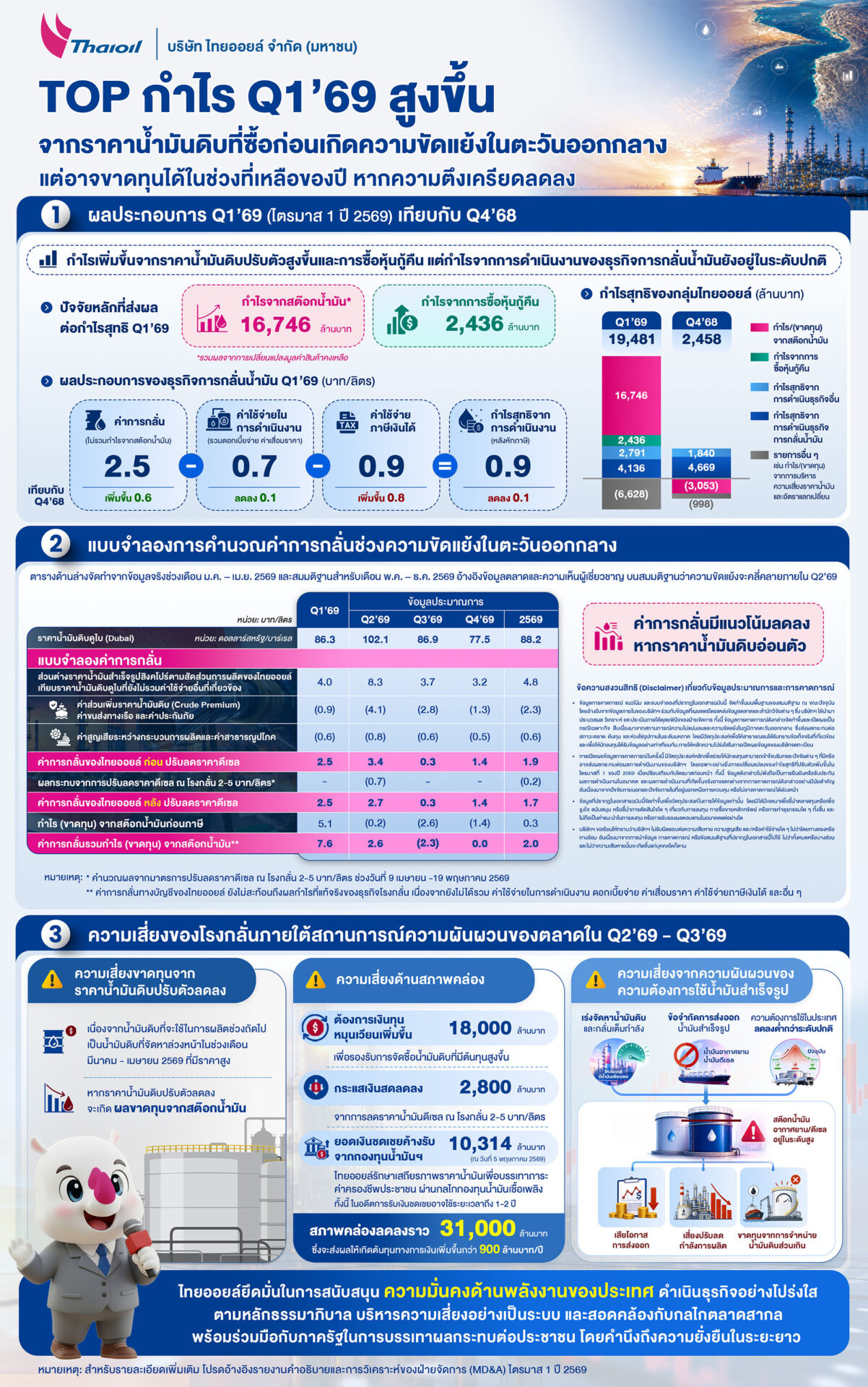
Mr. Pongpun Amornvivat, Chief Executive Officer and President of Thai Oil Public Company Limited, stated: “The performance in Q1/2026 recorded a net profit of THB 19,481 million, primarily driven by stock gain, net off write-down on crude and petroleum product inventory, totaling THB 16,746 million. The profit was supported by the short-term increase in crude oil and global refined oil prices resulting from geopolitical tensions in the Middle East from the end of February 2026 onwards. Furthermore, Thaioil’s normal business operations involve crude oil procurement approximately one to two month(s) prior to refinery production. As a result, crude cost recognized in Q1/2026 remained relatively low under the applicable accounting methodology, while the full impacts of price volatility arising from market tensions has not yet been reflected in Q1/2026 results.”
However, Mr. Pongpun noted that stock gain is temporary and could reverse into loss, should oil prices decline as geopolitical tensions ease. Additional gains during the quarter were also supported by bond repurchase worth THB 2,436 million.
Mr. Pongpun added: “Thaioil recorded other costs amounting to THB 6,628 million. After deducting stock gain, gain from bond repurchase, and these expenses, Thaioil Group’s net operating profit would stand at THB 6,927 million, including refinery operation profits of THB 4,136 million, or THB 0.9 per litre.”
Mr. Pongpun further stated: “The performance outlook in Q2/2026 remains uncertain and may move in the opposite direction from Q1/2026.” Thaioil identified the following key risk factors:
- Risk of stock loss from Q2/2026 onwards
Advance crude oil procurement to maintain maximum refinery utilization during the peak conflict period between March and April 2026 took place amid high volatility and elevated crude oil prices. Should geopolitical tensions ease, declining crude oil prices may lead to future stock loss.
- Risk of financial liquidity
- Thaioil required additional working capital by THB 18,000 million to support higher crude oil procurement costs.
- Cash flow reduced by THB 2,800 million from diesel ex-refinery price cut THB 2-5 per litre during 9 April to 19 May 2026.
- Delayed reimbursements from the Oil Fuel Fund amounting to THB 10,314 million as of 5 May 2026 may further weaken liquidity. Based on historical experience during the Russia-Ukraine conflict, reimbursements took approximately one to two year(s).
As a result, Thaioil’s liquidity is expected to decline by THB 31,000 million, excluding additional financing costs and increased interest expenses approximately THB 900 million. The company stressed that these additional burdens are temporary and are not being passed on to consumers, as the measures are intended to support Thailand’s national energy security.
- Risk of domestic demand volatility
- Opportunity loss occured from limitations on refined oil exports during periods of elevated prices, while domestic demand softened. Export product distributions are deferred, while price is likely to decrease.
- Risk of utilization rate cut : Despite market headwinds, Thaioil has maintained high refinery utilization rates to support Thailand’s energy security while export opportunities remain constrained. This situation has resulted in increasing refined oil inventories and approaching the maximum levels. Utilization rate may be reduced in the near term to maintain safety and optimum level of refined oil inventories.
- Potential loss on crude sales : Urgent crude oil procurement during periods of intensified geopolitical conflict was necessary to ensure that refinery operations could continue at maximum capacity. However, some excess crude oil inventories may need to be sold at market prices which may be below procurement costs, potentially resulting in loss on crude sales.
Thaioil reaffirmed that comprehensive supply chain management remains a core pillar of national energy security. The company aims to mitigate impact on all stakeholders while ensuring uninterrupted oil procurement and operation despite elevated crude oil prices and procurement costs. The impacts are expected to become more visible in upcoming quarterly reviews. Continued uncertainty is likely to affect operating performance throughout Q2/2026 and the second half of the year. Future challenges will depend largely on global oil price movements and supply-demand dynamics. Should geopolitical tensions ease and oil prices decline, additional impacts on operations and liquidity may emerge for Thaioil Group.
Thaioil reiterated its commitment to maintaining Thailand’s energy security and stability through transparent operations under strong corporate governance principles, while continuing to strengthen risk management capabilities to navigate future volatility and maintain an appropriate balance among all stakeholders, including its shareholders, as a listed company.